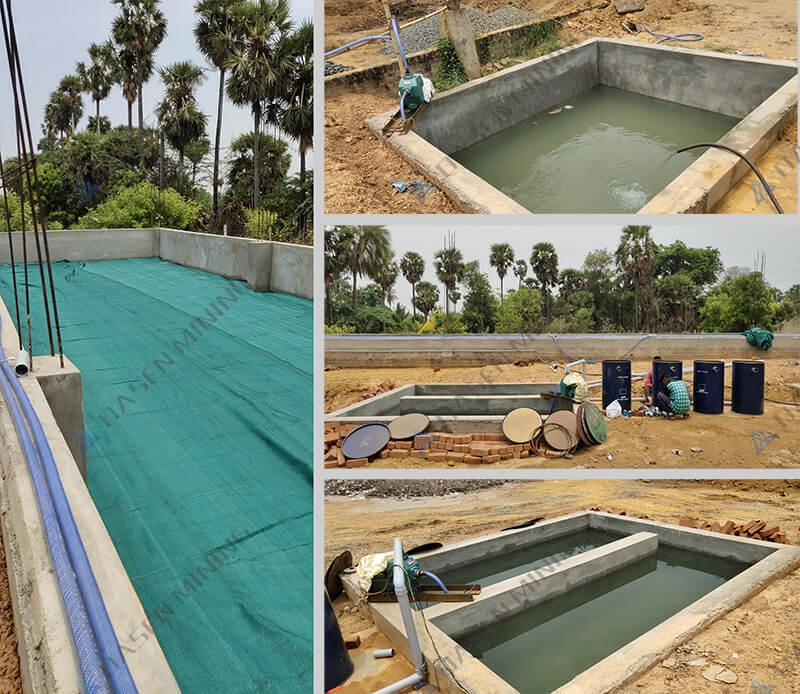
Pit Leaching Process
The main ore used in the pool leaching process is gold ore, which is usually used in gold mine tailings.
It requires the use of sodium cyanide or environmentally friendly gold extraction agents, just like the cyanidation carbon leaching process.
From a technical perspective, the recovery rate of the pit leaching process is lower than that of the cyanidation carbon leaching process, because no equipment is used, only relying on the natural reaction of ores and reagents, and the control of particle size is not as strict as that of the cyanidation process.
The followings are the technical requirements for the pit leaching process:
Particle size:<0.1mm Recovery rate: 80-90% Cyanide concentration: 0.05-0.1% Spray liquid: 100L/T PH value: 10-11 Pool immersion time: 7-15 days The maximum treatment capacity of pool leaching can be 10000 tons *For pool leaching, the smaller the particle size, the more beneficial the leaching result.
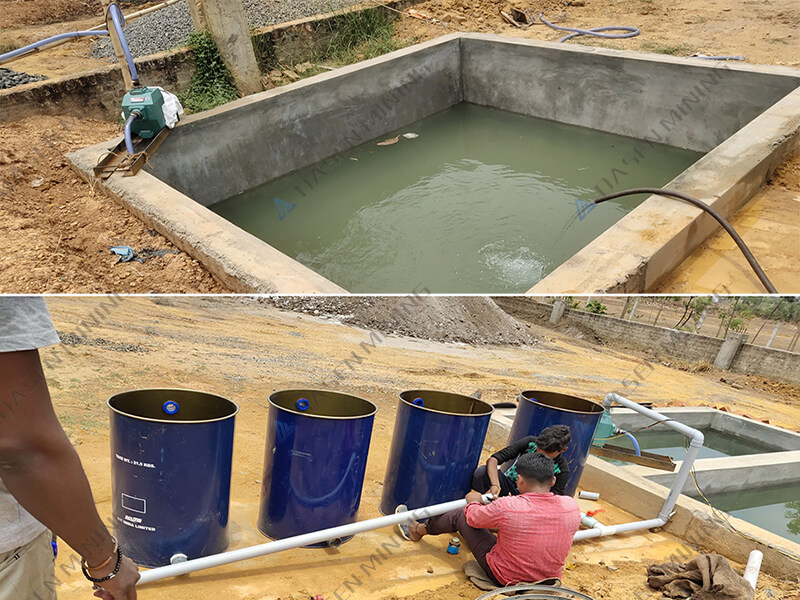
From an economic perspective, the pit leaching process does not require too much equipment, which can save a lot of equipment costs. Secondly, the pit leaching cycle is generally relatively short, with a relatively small consumption of manpower and resources, making it more suitable for gold mine owners who do not have a large budget.
At present, the application of pit leaching technology in foreign gold mining areas is also very common. The main difficulties in operation are in leaching technology, reagent use, and active carbon-loading gold smelting. As long as the above three points are not problematic, mine owners can basically obtain good results.
Advantages
- Since there are no expensive and arduous shafts or stripping projects, and no rock drilling, blasting, ore transportation and crushing processes, the infrastructure investment is small, the construction period is short, and the production cost is low.
- Good environmental protection, basically not destroying farmland and forests, and not polluting the environment.
- It has fundamentally improved the labor and health care conditions of production personnel.
- It can make the heavy and harsh mining work “chemical”, “factory” and fully automated.
- Ability to make full use of resources. For example, for some poor mines, buried isolated ore bodies, scattered small ore bodies, and mineral deposits with complex hydrogeological engineering conditions, conventional methods are often inexperienced and even technically infeasible, and land is used. The dipping method is often quick and easy.